On joining NYC’s Community Emergency Response Team
Overcoming the disaster hero narrative, and embracing the mundanity of the work
Hi! Me and this newsletter are back from finishing a podcast series - the benefit of being a free and occasional thing is that I post when I have something to say, and I don't when I don't. But with that show done, expect to see me a little more often - Kat
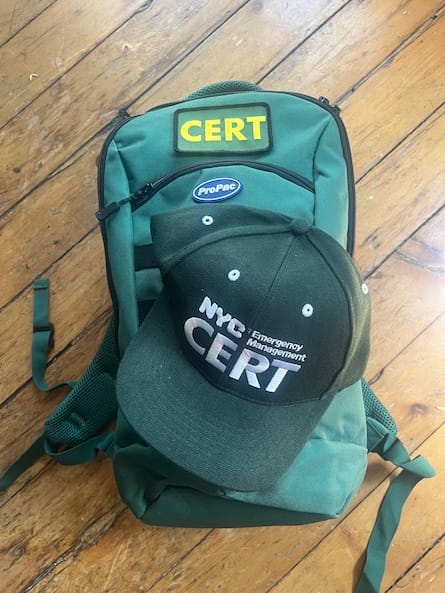
In December, I became a (probationary) member of New York City’s Community Emergency Response Team, or CERT. It’s a program run by NYC Emergency Management, and it trains New Yorkers to support their neighbors, and first responders, before and after disasters.
New York is a city of 8.5 million people, give or take. I’m pretty sure that my graduating class of CERT trainees brought the total of CERT members to 832. So, about .01 percent of the population. I think way, way more people should get trained and join. Here’s my pitch:
You will learn genuinely cool and useful skills
Firefighters from the FDNY taught us how to use a fire extinguisher, which is something I conceptually knew how to do, but was very glad to have the chance to practice. EMTs taught us how to use a tourniquet. We learned basic search and rescue, how to use found materials and teamwork to lift heavy objects off of people, and mass casualty triage. Chances are we’ll never be called on to use those skills (I really hope not) but I’m glad to know how to do them.
You will meet really interesting people you’d never meet otherwise
The people getting trained were from all over the city, and of all ages, races, backgrounds. I made friends with people way older and way younger than me, people who’ve lived here their whole lives and people who arrived last year (not to sound like Mamdani but it’s true). And now, post-training, I’m meeting neighbors I wouldn’t necessarily have met - CERT is organized geographically, so once you’re trained you get assigned to the division for where you live. So I’m connecting with people in my community who also care about preparedness and community.
You can help your neighbors get prepared, and build safety
It’s worth saying that a lot of what CERT folks do is not terribly glamorous. It’s traffic management at parades, helping out at soup kitchens, handing out preparedness info at community events. CERT members get asked to clear storm drains of leaves, before big rainstorms, or shovel out crosswalks and fire hydrants after a storm. Fun fact: a lot of the snow measurements in the city come from CERT volunteers, who get asked to measure snowfall and report it to emergency management.
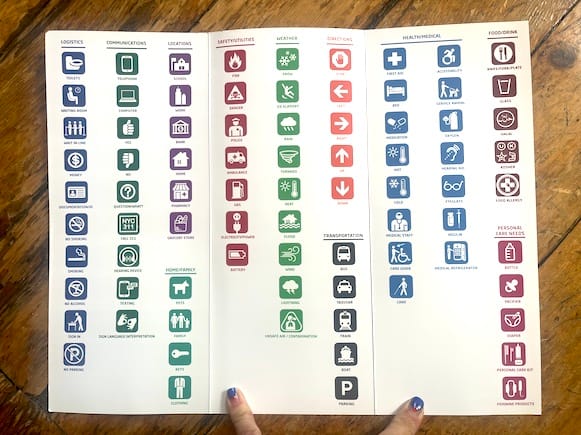
That trifold thing above was a tool we were given in CERT. It's an emergency communication board, for people who may not share a language or who are nonverbal to be able to communicate basic needs by pointing at the relevant icon.
Sometimes you’re asked to be a role player in big training exercises for first responders - I did that in December and it was deeply weird and pretty cool. My assignment was “ambulatory person with arm injury”, so I got really gruesome arm makeup and had to pretend to be injured.
You get to pick what events you participate in, so if clearing drains or fake wounds isn’t your thing, that’s okay. You just have to do a certain number of hours a year.
To me the mundanity of the work is part of what’s special. Preparedness often has a hero narrative - people want to be the big savior in the big crisis. But really, the slow, delicate work of showing up for your community, steadily and patiently, that’s what builds real safety, as much as anything can.
How to join CERT
If you’re in New York, you can find more info here. And if you have questions about it, let me know! It’s six weeks of training, twice a week in the evenings, so it’s a time commitment, but to me, worth it. And for people outside New York City, there are CERTs in every state, so search around for when your city/area is doing their next cycle.
Government-sponsored teams like these are just one piece of the preparedness puzzle, the care-taking puzzle. They can and do exist alongside essential community initiatives for protecting immigrant neighbors, feeding hungry neighbors, and developing grassroots flood warning tools. But for people in places where the local government isn’t actively trying to destroy you, and maybe even genuinely cares for your survival and well-being, connecting to official preparedness channels might be worth doing. It’s given me new insight into the tools and resources available, and how I can connect them to my communities. Maybe more than anything, it’s given me consistent hope in a time where that can be scarce. It’s really nourishing, to regularly be in a room of people who want to show up for strangers in a time of crisis. And to know that there are 832 people like that out there in my city, and more every day.