Preparedness as community care
On apocalypse-proofing kids, interdependence, and New York City’s Community Emergency Response Teams
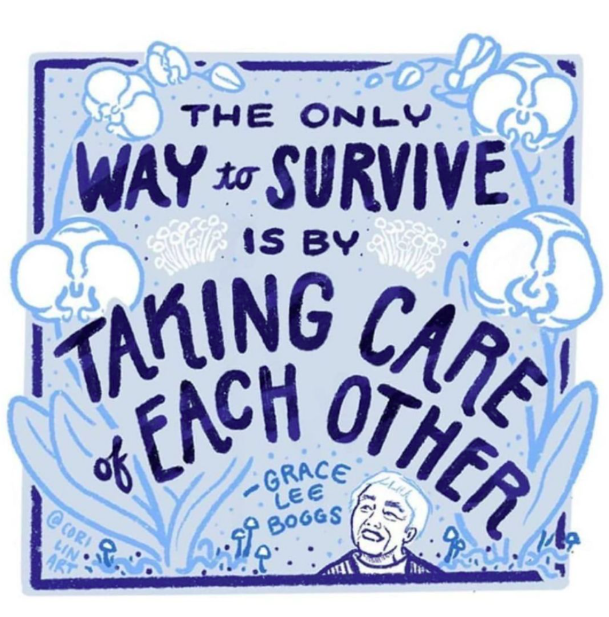
On apocalypse-proofing kids, interdependence, and New York City’s Community Emergency Response Teams
I try very hard to hold certain truths clearly in hard, turbulent times. One of those clear truths is that we can’t go it alone. Not one of us can. But boy, do some of us like to try.
On one level, there is some inherent selfishness in prepping. I’ve taken steps to prepare my family for some relatively minor disasters. We have go bags, and food to shelter in place, and basic supplies for emergencies. That’s effort focused on my immediate personal needs. But - and it’s taken me a while to realize this - preparedness is also an act of community care. If my family can hold ourselves down for a few days, that frees up resources for responders to care for others. The choices I make affect the options available to others. Interdependence doesn’t stop in a crisis. It becomes more critical.
Interdependence and preparedness came up recently in two magazine stories. One in New York Magazine, about parents trying to prepare their kids for the apocalypse. The other in the New Yorker, about homeowners in California trying to fireproof their houses.
The NYMag one was called “The Techno Optimist’s Guide to Futureproofing Your Child,” with a subhed that read “AI doomers and bloomers are girding themselves for what’s coming — starting with their kids.” (I don’t even know what a bloomer is, but never mind that.) Some dimensions of the permeating anxiety in the story resonated with me. The people in the pieces are all wondering how to best prepare your child for the future when the future is profoundly uncertain. A question I ask myself all the time.
For a lot of parents in the piece, written by Benjamin Wallace, the answer is to develop kids with “agency”. This is apparently a big buzzword. Some parents pursue agency by sending their kids to the Alpha School, a small but growing chain of AI-driven private microschools. Where they do some stuff that sounds cool, but a lot of stuff that sounds dystopian - much of the learning seems to be guided and graded by AI, on tablets, with minimal classmate interaction.
At the flagship campus, a second-grader, in order to ascend to third, must complete a checklist that includes running five kilometers in 35 minutes or less; delivering a two-minute TED-style talk with “zero filler words, 120–170 [wpm] pace, and 90% confidence,” as judged by an AI speech coach named Yoodli; and calling “a peer’s parent” to “independently plan and schedule a playdate.”
Other families in the piece homeschool under a framework called The Sovereign Child, with minimal boundaries. One parent lets a kid slap their hand over his mouth because the kid is bored of him talking, and lets a young child play close to a hot grill. That doesn’t sound like agency, it just sounds rude (or dangerous).
And look, I am all for my kids having agency. I encourage them to question me, question the world around them, take action when they see things that warrant changing. But I also want them to recognize that their actions affect others, and affect others in turn. That as Dr. King said, they are part of “an inescapable network of mutuality, tied in a single garment of destiny.”
There’s the rub, though. I think a lot of people want to escape that network, and are trying to buy their way out of it, with bunkers and fancy schools and property in New Zealand and rockets to Mars.
Which brings me to that California wildfires article. It’s about the unfortunate reality that half-measures in fire-proofing aren’t enough. You kind of have to do every single item on the fire-proofing list to protect your home. And even that’s not enough, actually, because “no home is an island, and dense housing developments can protect themselves only if every neighbor does the same work.”
But as the author, Ingfei Chen, found, much online guidance around fireproofing shows a house on an isolated parcel of land. No acknowledgment of most people’s reality, which is that we have neighbors. Homeowners are told to move sheds or piles of firewood away from their houses, Chen writes, but that often just means moving it closer to your neighbor. And as one expert tells Chen, ‘fire doesn’t care about who owns what.” Protecting yourself without considering the neighbors will bite you in the ass, fire-wise, and then everyone’s house goes up in flames.
You know who totally gets this network of mutuality thing, though? New Yorkers. I’m doing the city’s CERT training right now, learning skills to join the Community Emergency Response Team, and I am obsessed. Two nights a week, I spend three hours with the most diverse group of New Yorkers I’ve sat with in a long time. People from an incredible mix of races, ages, boroughs, religions, backgrounds, professions, all volunteering a lot of time to learn how to spend even MORE time volunteering to help strangers who might need help.
I’m sure I’ll write more about CERT soon (and please, let me know if you have questions!) but being in that room has been such a balm to my soul. Dozens of people gathering for the chance to help their neighbors. Learning how to cooperate in crisis. That, more than anything, is what I think can save us. I don’t think futureproofing exists, but collaboration across divides is pretty high on my list of zombie apocalypse skills. Way more than learning how to give a TED talk.