What is going on with FEMA?
TL;DR: Uncertainty, leadership upheaval and staff loss. Which makes community care even more critical.
We’re now on our third person leading FEMA this year. The acting FEMA administrator, David Richardson, resigned recently, apparently under threat of being fired. He infamously said in June (during hurricane season) that he wasn’t aware that there is a hurricane season, and then said it was a joke.
Richardson had replaced Cameron Hamilton, who had himself been kicked off the job in May, after telling Congress in testimony that he didn’t think FEMA should be eliminated.
For now, the agency will be led by Karen Evans, the agency’s current chief of staff.
But it’s not just turmoil at the top. About 2,500 staffers left the agency in the first six months of 2025. That’s not just a loss of people power, it’s a loss of institutional knowledge and inter-agency relationships. As the GAO recently put it, “FEMA staffing shortages could mean disaster for future response efforts.”
Current and former FEMA staffers wrote a true banger of a letter this summer, called the Katrina Declaration, basically saying that the current state of FEMA risks another Katrina-level crisis. (Fourteen people who signed the letter were then put on administrative leave, then taken off leave, then hours later were told that was a mistake and were put back on administrative leave, which sort of just proves their point that things are kind of a mess, no?)
Of course, this is all happening with a backdrop of the administration saying it wants to eliminate FEMA altogether.
The details of the proposed plans haven’t been released yet. But the task force created by the administration to draft reforms seems to be recommending changing FEMA rather than dismantling it. But there’s also reports that the agency might be moved to Texas? So… we’ll have to wait and see on that.
What does this mean for us, regular people just trying to survive?
Of course, I don’t know for sure. I can make some guesses. I would guess that in the event of a disaster, funding from the federal level will not flow as fast as it might have before. Funding bottlenecks were blamed in part for response failures during the Texas floods, for example. If you live in a state or city whose leadership is not aligned with the current administration, I think it’s possible that could affect funding too. The governors of Maryland and Washington states have argued that’s already happening.
Funding to fight wildfires was cut. Staffing at the office responsible for post-disaster housing recovery was cut. Some FEMA employees were reassigned to ICE. The administration tried to tie FEMA funding to immigration enforcement, was told by a judge it couldn’t do that, and then seems to be ignoring that. So, all that’s happening.
There’s also the impact on preventing disasters, not just responding to them. The disaster cycle is typically depicted as a circle, with four steps: preparedness, mitigation, response, and recovery.
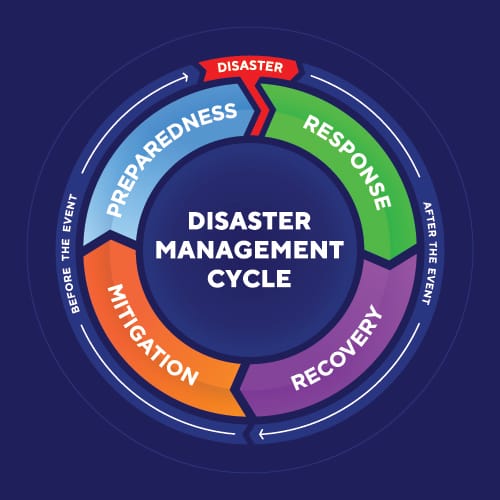
Because disaster management is a circle, cutting or politicizing funding isn’t just about whether someone will come to the rescue in the immediate aftermath of a disaster (aka, the response phase). It’s also about the resources available for reducing the impact of future disasters through mitigation. In April, FEMA cancelled two big mitigation programs, the Building Resilient Infrastructure and Communities (BRIC) program and the Flood Mitigation Assistance program. This, according to the National Association of Floodplain Managers, is very bad. (Then states sued, a judge intervened, current status unclear, chaos reigns).
All that said, everyone I’ve met in the emergency management field really, really (like REALLY) believes in what they do. It’s essentially impossible for me to imagine that the people whose life's work is to respond to emergencies will not find a way to show up. Oversimplifying slightly, disasters are managed from the bottom up, which means that local and state responders get called first. And they will move heaven and earth to care for their communities.
What’s actually next, and what should we do?
As ever, I’m going to say that community building is the best survival strategy. If there’s going to be less federal funding for recovery, and mitigation, then that work - and cost - will fall to state and local governments. Which, on the upside, might create more opportunities for engaged people to have a voice. Maybe your community group wants to join your local chapter of VOAD, Volunteer Organizations Active in Disaster?
On a more micro level, individual preparedness is also potentially going to be more important. I’m working on a post about go bags for kids and adults, and then one on what I try to keep on hand at home (food, basic medical supplies, water, etc). But again, sharing that information is a form of community building, so yeah, it all comes back to that: the unglamorous (but often joyful!) work of weaving the social fabric.
On another note, a resource: Stop The Bleed
As part of my CERT class (more on that soon, promise - I am so geeked about it!), we learned how to use a tourniquet and how to improvise one. The trainers recommended the Stop the Bleed course as the gold standard class for learning how to, well, stop bleeding. The Brooklyn Public Library offers those classes over zoom monthly, and you can sign up here.