Don't you dare say we're cooked
How hanging out with 700 natural hazards experts gave me a jolt of hope and joy
When I tell people that I’m studying emergency management, the most common response is “Wow, that must be SO depressing.” And yes, it is basically deep thinking about everything that can go wrong, from natural hazards or human error or human intention.
But I just went to a conference in Colorado, and it captured why I always say no, the opposite - it’s actually so heartening. Because studying emergency management is also learning about people’s creativity and commitment to minimizing harm and maximizing care.
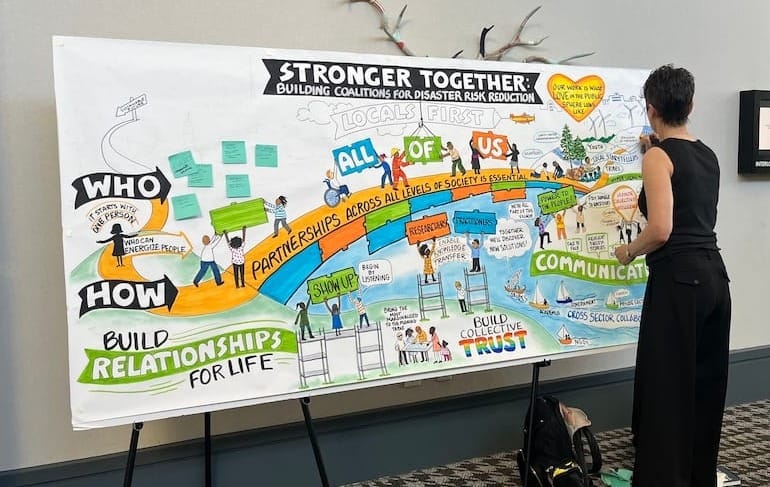
The Natural Hazards Workshop is an annual gathering of people trying to navigate natural hazards. Storms, heat, cold, floods, earthquakes, the greatest hits. The conference is in its 51st year, and has grown from a few dozen people to almost 700. It’s academics and nonprofit workers and state and city and local government workers, and students, sociologists and anthropologists and meteorologists and geographers and even more kinds of people, all focused on how we survive, and survive together. I loved it.
I talked to people working on heat in prisons, on shelter safety for trans and gender-non-conforming people in evacuation, on masculinity and climate vulnerability, on culturally responsive visual iconographies, and so, so many other subjects. I felt like my brain was overflowing, in a good way.
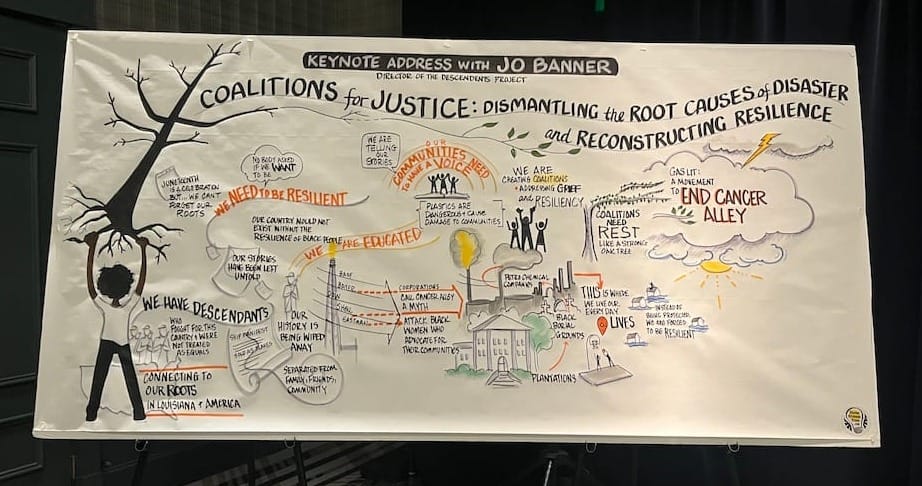
Jo Banner, of the Descendants Project in Louisiana, talked about the land she calls home, and the residents, animals, and ancestors who share it. The storms that flood the waterways, and the plastics companies that pollute them. She talked about her resentment at the imposition of resilience, and the need for space to rest and grieve. She talked about the resurrection fern, which curls up and looks dead when the weather is dry, conserving its energy, resting, then unfurls and thrives when the conditions are right.
I met a woman named Imani Daniel, who runs a group called VISION, the Virgin Islands Institute for Social Impact, Opulence, and Noetics*. Imani talked about how after disaster, the relational infrastructure will come back before the physical infrastructure. And she talked about how in resource-strapped places like the Virgin Islands, groups like hers have to make sure what they’re doing is working. So she’s working with researchers to test and measure outreach strategies, because, she said, she has a responsibility to do the most she can to help her people.
This is my kind, our kind, of disaster thinking. It’s not the militarized, hierarchical command-and-control framework. It’s human, natural, thoughtful, inclusive. Sanguine but not hopeless.
On that sanguine front, there were also panels about the future of FEMA and what’s ahead for disaster management in America. You’ll probably remember that President Trump created a council to “assess” FEMA back in January of 2025, then said that he wanted to get rid of FEMA altogether. That council was supposed to develop recommendations, which were going to be released in December 2025 but that got scrapped when some of them leaked. The recommendations finally came out in May, and has some good and some bad. The Federation of American Scientists puts it like this:
The Good: An emphasis on mitigation and streamlining the application process for disaster survivors, along with a focus on getting money to states and survivors quicker.
The Bad: Shrinking and privatizing most of the National Flood Insurance Program (NFIP), while slashing overall federal funding for disaster response and recovery.
The Ugly: An unrealistically short timeline for implementing recommendations in the report, as well as a reductionist approach to how disasters enact damage.
(That’s from a post called Disaster Policy Nerds Explain the Good, Bad, and Ugly in FEMA Review Council Report, which has a good, 8-min-read summary of the report.)
Meanwhile in Congress, we have the bipartisan FEMA Act of 2025, which would move FEMA out of DHS, among other things. There's overlap between the report’s recommendations and the bill, but they’re moving on different timelines.
What’s not on a flexible timeline is the 2026 hurricane season. FEMA funding and staffing are both pretty up in the air right now, and I don’t think it’s overstating things to say that has some people, including the very knowledgeable people at this workshop, a little worried.
Here’s the thing, though. Not once did I hear anyone say the thing I hear so often, when people talk about climate crisis, or the government: we’re so cooked. No one there expressed despair, or hopelessness. Anger, frustration, outrage, of course. But the conversation, over and over, was sharing ideas for building bigger, stronger coalitions, inviting in more people, being more intentional in our care and stewardship of this planet and each other.
I can’t even begin to calculate the centuries of expertise that were in those rooms. The hundreds of people who have been working to avert disaster for decades, alongside those new to the field bringing new strategies and ideas. If they haven’t given up, you can’t either.
*What are noetics, you ask? The literal definition is essentially related to the intellect, but it’s often used also to mean something involving intuition beyond ordinary sensory perception.